
Loading

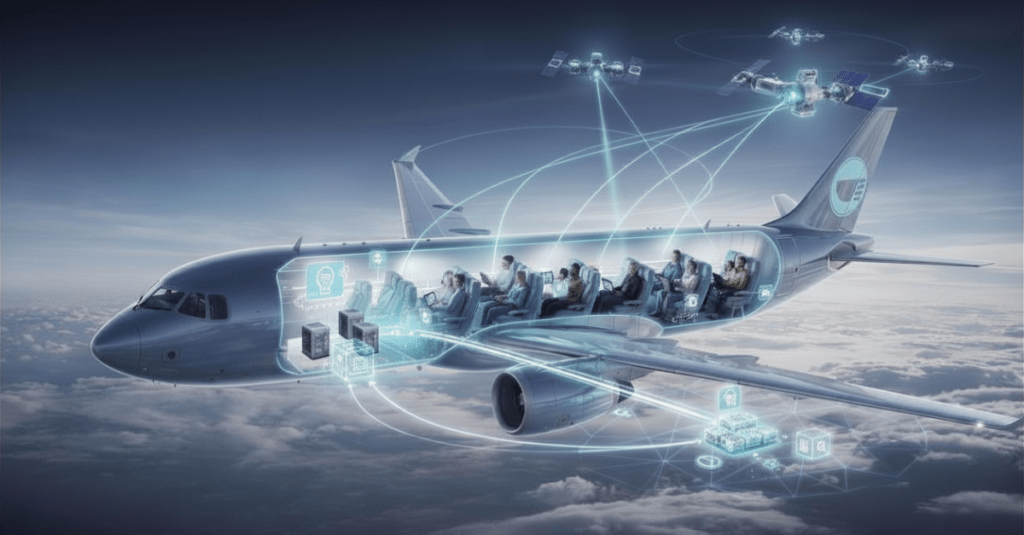
Low Earth Orbit (LEO) satellite constellations have transformed expectations for inflight connectivity. Lower latency, higher peak throughput, and global coverage are making the idea of a “fully connected aircraft” increasingly realistic.
But as connectivity scales across fleets, a critical realization is emerging across the aviation industry: bandwidth alone will not solve everything.
At industry discussions such as APEX Tech 2026, experts emphasized that the real challenge is not just connecting aircraft — it is delivering data efficiently at scale. Edge caching is rapidly becoming a key part of that solution.
One of the main advantages of LEO networks is reduced latency. Because satellites orbit much closer to Earth than traditional GEO systems, the delay in communications is significantly lower.
However, lower latency does not eliminate a fundamental constraint: capacity must still be shared.
A single aircraft may have hundreds of passengers connected simultaneously. Multiply that by dozens of aircraft flying the same routes and the demand quickly escalates.
Industry experts point out that even modest streaming usage scales quickly. A typical video stream of 5–6 Mbps multiplied by hundreds of passengers can rapidly consume available bandwidth, forcing operators to optimize traffic management carefully.
In other words: The better connectivity becomes, the more passengers use it. This phenomenon — sometimes called induced demand — means networks must become smarter, not just faster.
Edge caching is based on a simple principle: store popular content closer to the user instead of repeatedly retrieving it from distant servers.
In aviation, that “edge” may exist in several places:
– Ground-based gateway data centers
– Regional content distribution nodes
– Onboard aircraft servers
By caching frequently requested content locally, the system avoids sending identical data repeatedly through the satellite link.
Instead of streaming the same movie, social media asset, or software update hundreds of times via satellite, the system retrieves it once and serves it locally afterward. This dramatically reduces network load while improving performance.
One of the key insights highlighted at APEX Tech discussions is that the inflight ecosystem is evolving toward a hybrid model. Passengers increasingly expect streaming services and real-time content updates similar to what they experience at home.
Yet it is unrealistic to cache entire streaming catalogs onboard. Instead, intelligent systems combine:
– Cached content for high-demand titles
– Dynamic streaming for long-tail or personalized content
– Real-time updates when connectivity allows
This hybrid architecture ensures reliability while preserving flexibility.
Passengers can enjoy fast access to high-demand content while still benefiting from the openness of internet connectivity.
Industry discussions increasingly highlight the importance of balancing pre-positioned content and connected services.
In practice, this means:
– core entertainment libraries are cached onboard the aircraft
– frequently requested digital assets are refreshed at the network edge
– live or personalized content is streamed when bandwidth conditions allow
This architecture allows airlines to maintain a rich onboard experience while keeping satellite traffic under control.
It also helps ensure that key services remain available even if connectivity conditions fluctuate during flight.
It may seem counterintuitive, but faster connectivity actually increases the importance of caching.
As passengers gain access to better connectivity, new types of traffic appear:
– high-definition streaming
– cloud applications
– gaming platforms
– real-time messaging and collaboration tools
– data synchronization across personal devices
All these services compete for the same satellite resources.
This is why many experts now emphasize that network intelligence at the edge will play a decisive role in scaling connectivity successfully.
Modern IFEC systems are evolving into edge computing platforms, rather than simple entertainment servers.
Today’s onboard systems can:
– cache popular digital content
– host applications locally
– process passenger interaction data
– synchronize with airline ground systems
– dynamically prioritize critical traffic flows
This effectively turns the aircraft into a distributed node within a global digital network.
Processing data locally reduces the amount of information that needs to travel through satellite links, improving both performance and reliability.
Passenger expectations continue to rise, but speed alone does not define a good connectivity experience. In many cases, passengers value reliability, responsiveness, and consistency more than raw bandwidth.
Edge caching helps deliver these qualities by ensuring that core services remain available even when satellite capacity fluctuates or demand peaks.
A stable experience — where applications respond quickly and content loads smoothly — often matters more than headline download speeds.
Edge caching is not limited to entertainment services.
It increasingly supports a wide range of connected aircraft functions, including:
– operational applications
– onboard retail platforms
– predictive maintenance data
– passenger analytics
– digital service platforms
As aircraft become fully connected digital environments, managing data flows efficiently becomes essential. Edge architectures make this possible.
The next generation of inflight connectivity will not be defined by satellites alone. Instead, it will rely on a layered architecture combining:
– multi-orbit satellite networks
– intelligent traffic routing
– edge caching
– onboard computing
– cloud-based orchestration
Satellites provide the connectivity infrastructure. But edge intelligence determines how efficiently that connectivity is used.
LEO constellations are redefining what is possible for inflight connectivity. Lower latency and increased capacity are unlocking new passenger experiences.
But as digital demand continues to grow, network efficiency becomes just as important as network speed.
Edge caching offers a powerful way to reduce redundant traffic, improve streaming performance, and ensure connectivity can scale across global fleets.
As the connected cabin evolves, one thing is becoming increasingly clear: Satellites provide the link — but the edge makes the experience work.
TRAVELER’S MICRO-MOMENTS Home Capturing the Traveler's Micro-Moments 26 April 2022 microMoments, Technology, traveler Time Is No Longer Measured in Days,…
IFE TO THE RESCUE Home WHEN IFE COMES TO THE RESCUE OF FLIGHT ATTENDANTS! 25 June 2022 Digital Services, IFE,…
Digital AD: IVT-FREE Zone Home DIGITAL INFLIGHT ADVERTISING: AN IVT-FREE ZONE 20 May 2022 Advertising, IVTFREE, Technology In late 2015,…