
Loading

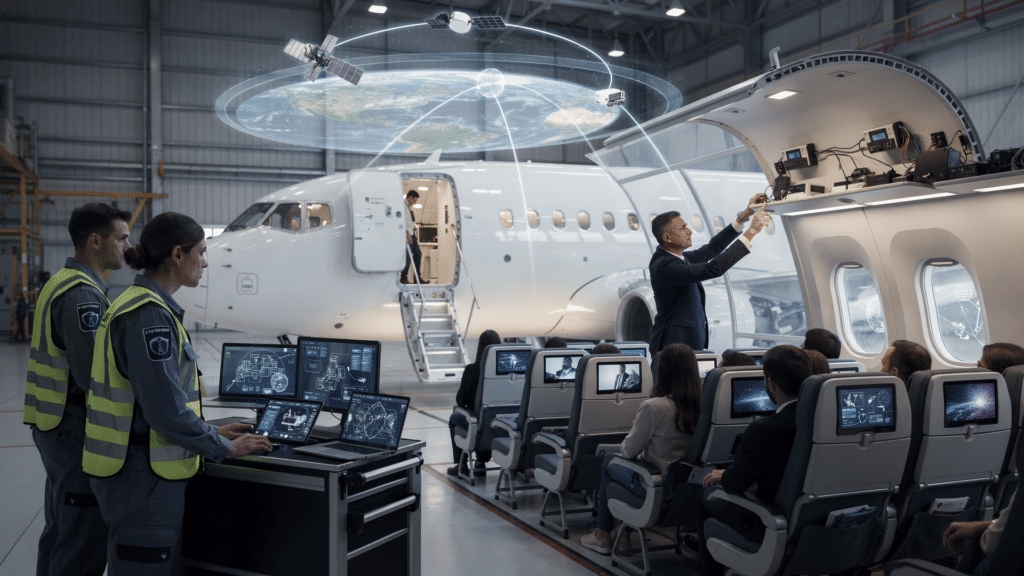
The aviation industry is witnessing a fundamental shift in how airlines approach cabin modernization. What was once a straightforward maintenance relationship between airlines and their MRO providers has evolved into something far more strategic. Today’s MROs aren’t just fixing aircraft—they’re integrating advanced technologies, managing complex certifications, and helping airlines deploy cutting-edge passenger experience platforms. At the center of this evolution sits wireless IFE and in-flight connectivity systems, technologies that are rewriting the economics of cabin retrofits while creating new competitive advantages for forward-thinking carriers.
This transformation comes at a critical moment. Passengers expect seamless high-speed internet at 35,000 feet, and sustainability mandates are pushing carriers toward lighter, more efficient cabin solutions. The MROs that can navigate this complex landscape—integrating wireless IFE platforms, deploying LEO satellite connectivity, and managing the certification maze—are becoming indispensable strategic partners rather than transactional service providers.
Two key forces are accelerating cabin modernization and creating new opportunities for MROs with technology integration capabilities.
First, airlines are looking to reduce cabin weight while increasing the value delivered to passengers. Whether through new aircraft deliveries or the modernization of existing fleets, airlines are under increasing pressure to improve fuel efficiency and reduce emissions. Cabin equipment is therefore an important area for weight optimization, particularly as every kilogram can contribute to fuel savings over an aircraft’s operational life. Initiatives such as the EU’s ReFuelEU Aviation regulation further reinforce the industry’s focus on efficiency and emissions reduction. The opportunity is not simply to remove weight, but to replace heavier legacy equipment with lighter technologies that deliver greater perceived value—from richer digital experiences and personalized content to connectivity and onboard services. The growth of the cabin interiors market, projected from USD 29.22 billion in 2026 to USD 38.00 billion by 2031, alongside a projected 6.82% CAGR for the IFE systems segment, reflects continued investment in cabin modernization and technology.
Second, passengers increasingly expect reliable connectivity throughout the journey. Internet access is moving from a premium feature to an expected part of the onboard experience, driven in particular by the expansion of LEO satellite connectivity. Passengers accustomed to streaming, messaging and accessing cloud services on the ground increasingly expect a similar level of digital access in the air. For airlines, this means that cabin modernization can no longer be considered separately from connectivity. IFE, onboard services and connectivity increasingly need to work together to deliver the seamless digital experience passengers now expect.
This shift creates a broader role for MROs: beyond installing or maintaining cabin systems, they can increasingly help airlines determine how to reduce weight, modernize the passenger experience and integrate the technologies needed to meet evolving connectivity expectations.
The shift toward wireless IFE platforms represents one of the most significant changes in cabin retrofit economics over the past decade. Traditional embedded seat-back screens required extensive wiring infrastructure, heavy hardware installations, and lengthy aircraft downtime. Wireless solutions built on Bring Your Own Device (BYOD) technology flip this equation entirely. For a large number of airlines it is far more relevant to replace outdated seatback screen monitors by in seat power, smart tablet/smartphone holder and BTYOD experience
Weight reduction delivers immediate and ongoing financial benefits. Eliminating traditional seat-back screens reduces aircraft weight by approximately one ton per aircraft, translating to annual fuel savings of around USD 50,000 at current jet fuel prices. For a fleet of 100 aircraft, this represents USD 5 million in annual fuel cost reduction—a compelling business case that improves with every fuel price increase. Weight reduction from wireless solutions can remove approximately one ton from each IFE aircraft configuration, creating measurable sustainability improvements alongside cost savings.
Capital expenditure drops significantly. Modern wireless IFE systems eliminate expensive embedded hardware, wiring infrastructure, and seat modifications that traditional installations require. This makes wireless solutions particularly attractive for low-cost carriers prioritizing operational efficiency, but the economics work for full-service carriers as well, especially when deploying across large fleets or on shorter-haul routes where embedded systems are harder to justify.
Airlines implementing wireless IFE solutions are achieving fuel savings of approximately USD 50,000 per aircraft annually while reducing the aircraft downtime that represents lost revenue opportunity.
Maintenance complexity decreases substantially. Wireless systems eliminate the maintenance demands associated with embedded hardware, including screen replacements, wiring repairs, and software updates requiring physical access to seat-back units. This reduction in maintenance burden frees up MRO resources for higher-value activities while lowering total cost of ownership over the system’s lifecycle.
Content flexibility improves operational agility. Airlines can update content libraries remotely without hardware constraints, enabling rapid response to passenger preferences and seasonal programming changes. Modern ife system platforms support over-the-air updates and cloud-based content management, allowing airlines to refresh entertainment offerings without aircraft downtime or technician intervention.
The European commercial aircraft IFE system market is expected to reach USD 2.10 billion by 2030 at a 3.55% CAGR, with the aftermarket segment growing at 4.76% CAGR. This aftermarket growth is particularly significant for MROs, as it represents opportunities to bundle cabin upgrades with IFE installations during fleet modernization cycles, creating integrated service offerings that deliver more value than standalone maintenance contracts.
Technology evolves faster than aircraft, creating a fundamental mismatch that makes future-proofing essential. Depending on the selected architecture (steaback screen, hybrid or full BYOD) an IFE system installed today needs to remain relevant and valuable for 10-15 years, even as passenger expectations, connectivity options, and available technologies change dramatically. The platform you choose must be designed for evolution, not just current requirements.
LEO and GEO satellite connectivity readiness determines whether your system can take advantage of next-generation connectivity. Low Earth Orbit satellite constellations promise significantly higher speeds and lower latency than traditional geostationary satellites, enabling new capabilities like live content streaming, real-time personalization, and cloud-based services. Your IFE system should be designed to allow you to upgrade connectivity without replacing the entertainment platform.
Over-the-air update capabilities separate modern platforms from legacy systems. The ability to push most software updates, add new features, fix bugs, and refresh content without requiring aircraft downtime is invaluable. Modern IFE system platforms must support wireless connectivity and cloud-based services that enable continuous improvement. Physical access needs to be used only for very specific use cases such as certified software updates.
Modular architecture provides flexibility to upgrade components independently rather than replacing entire systems. Can you swap out media servers without changing seat displays? Can you upgrade connectivity modules without touching the content management system? Modular design reduces upgrade costs and extends platform life by allowing targeted improvements rather than wholesale replacement.
Open APIs enable integration with current and future airline systems, third-party services, and emerging technologies. A closed, proprietary platform limits your ability to add new capabilities, integrate with partners, or adopt innovative services. Open APIs allow you to connect your IFE system with loyalty programs, mobile apps, retail platforms, and future technologies that don’t even exist yet. This openness is essential for long-term value.
Each IFE system installation now includes connectivity infrastructure as a standard component rather than an optional add-on. The convergence of entertainment and connectivity is creating new technical requirements that MROs must master to remain competitive.
Delta Air Lines’ partnership with Amazon represents the largest LEO IFC deployment announced to date, signaling where the industry is headed. Beginning in 2028, Delta will equip 500 aircraft with Amazon’s Leo service, making it the first major carrier to implement Amazon’s satellite technology at fleet scale. The technical specifications are impressive: download speeds up to 1 Gbps through the aviation version of the Leo Ultra terminal, enabled by a constellation that currently has 212 satellites in orbit with rapid expansion planned.
Delta CEO Ed Bastian characterized the agreement as offering “the fastest and most cost-effective technology available to better connect the world today”, highlighting both performance and economic advantages that LEO solutions provide over traditional geostationary satellite systems. The partnership includes AWS integration enabling AI-powered services and enhanced passenger experiences that go beyond basic internet access.
Multi-orbit architectures are emerging as the industry standard. Delta maintains a strategic multi-vendor approach, continuing partnerships with Viasat and Hughes for Ka-band IFC services and hybrid solutions blending LEO and Geostationary Orbit (GEO) technologies. This ensures the right technology is deployed across different aircraft types to meet diverse operational requirements—long-haul international flights might use one solution while domestic short-haul routes use another.
MEO satellites positioned between GEO and LEO offer unique advantages by reducing latency while providing stable connections ideal for real-time applications like video conferencing and telemedicine. SES is developing a multi-band, multi-orbit, multi-beam electronically steerable antenna (ESA) solution combining MEO and LEO satellites, with the meoSphere system providing Ka-band MEO and Ka- or Ku-band LEO services starting in 2030.
Antenna upgrades represent a critical component of connectivity retrofits. The development of advanced ESA solutions enables seamless switching between satellite orbits and frequency bands, maximizing service availability and performance. The ife system aircraft integration process now requires expertise in both hardware installation and software certification, as these antenna systems must work flawlessly with cabin management systems, passenger devices, and ground-based network operations centers.
As aircraft become increasingly connected and digital, the role of MROs is evolving.
Airlines are no longer asking only: How do we maintain and retrofit this aircraft? They are also asking:
– Which IFE architecture makes sense for our fleet?
– Should we invest in Wireless IFE, seatback or a combination of both?
– How should IFE interact with LEO, GEO or hybrid connectivity?
– How can we reduce installation and maintenance costs?
– How can we prepare the cabin for future digital services?
– Which technologies can generate additional value through retail, advertising or personalization?
MROs are increasingly at the center of these conversations. Their knowledge of the aircraft, certification requirements, installation constraints and operational realities gives them a unique perspective on what is technically and operationally feasible.
But no MRO can—and should—be expected to master every technology across the rapidly evolving IFEC ecosystem.
This is where working with technology-agnostic integrators can make a difference.
Rather than being tied to a specific connectivity provider, IFE platform, hardware manufacturer or network architecture, an agnostic integrator can help MROs and airlines evaluate technologies according to the actual requirements of the aircraft and the airline strategy.
The objective is not to promote one technology over another. It is to connect the right components:
Aircraft → Connectivity → Antenna → Modem/ModMan → IFE platform → Digital services
This approach allows MROs to remain focused on what they do best—aircraft integration, maintenance, certification and operational execution—while relying on specialized partners to navigate the increasingly complex digital layer.
For airlines, this creates a more straightforward modernization journey.
Instead of managing multiple disconnected technology conversations, they can work with an MRO capable of bringing together the relevant expertise and coordinating the implementation.
For MROs, it creates an opportunity to move further upstream in the customer relationship: from executing a retrofit to helping airlines define what that retrofit should achieve in the first place.
The question is therefore no longer whether MROs should become technology companies.
It is whether they can become technology-enabled advisors, supported by the right ecosystem of specialized and agnostic partners.
The next generation of cabin modernization will not be built around a single technology or a single supplier.
It will require collaboration between airlines, MROs, connectivity providers, hardware manufacturers, software companies and technology integrators.
For MROs, the ability to advise airlines across this ecosystem—and to bring in the right technology partners without being locked into one solution—can become a significant differentiator.
The MRO of the future won’t need to provide every technology. It will need to know how to connect the right ones.
And for airlines, that may be the difference between simply upgrading an aircraft and building a cabin architecture that can continue to evolve for years to come.
TRAVELER’S MICRO-MOMENTS Home Capturing the Traveler's Micro-Moments 26 April 2022 microMoments, Technology, traveler Time Is No Longer Measured in Days,…
IFE TO THE RESCUE Home WHEN IFE COMES TO THE RESCUE OF FLIGHT ATTENDANTS! 25 June 2022 Digital Services, IFE,…
Digital AD: IVT-FREE Zone Home DIGITAL INFLIGHT ADVERTISING: AN IVT-FREE ZONE 20 May 2022 Advertising, IVTFREE, Technology In late 2015,…