
Loading

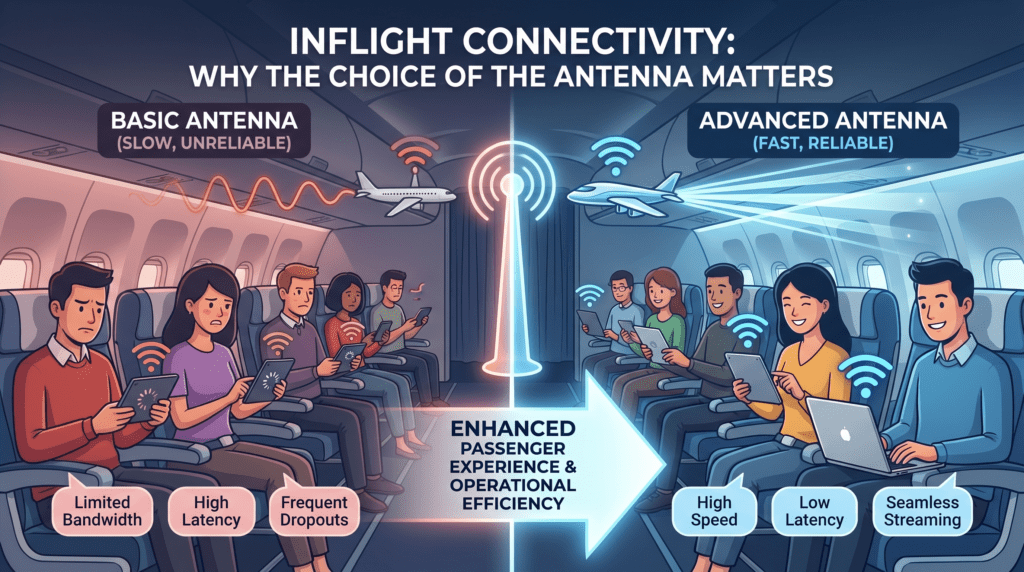
A recent viral post claimed that inflight connectivity has been misunderstood for years—that the real bottleneck isn’t the satellite constellation, but the antenna sitting on top of the aircraft. It’s a compelling narrative. It’s also an oversimplification. In reality, inflight connectivity is a system, not a single component. Satellites, antennas, modmans (modem managers), network orchestration, and onboard platforms all play a role.
And as airlines rethink their connectivity strategies—whether with LEO, GEO, or hybrid architectures—one thing is becoming clear: The antenna is critical—but it only makes sense as part of a much larger chain.
Historically, inflight connectivity relied on mechanically steered antennas—gimbaled dishes mounted on the fuselage, tracking satellites in geostationary orbit (GEO) at 36,000 km.
These systems were:
– Proven and reliable
– Compatible with Ku- and Ka-band GEO networks
– But mechanically complex, with moving parts, maintenance constraints, and performance that often fell short of growing passenger expectations.
Today, the industry has shifted toward Electronically Steered Antennas (ESAs):
– No moving parts hence a better MTBF (Mean Time Before Failure)
– Faster beam steering
– Lower maintenance
– Better suited for tracking LEO constellations moving rapidly across the sky
– Much higher data rates
The main key players are actively pushing this transition:
– ThinKom Solutions → hybrid-ready antennas (GEO/LEO compatibility)
– Panasonic Avionics → next-gen ESA for multi-orbit strategies
– Hughes Network Systems → IFC solutions combining antenna + network stack
– Gilat Satellite Networks → aero terminals for GEO and NGSO
– Kymeta / Thinkom → flat-panel ESA innovation
The takeaway: antenna technology is evolving fast—but it’s evolving to support multi-orbit realities, not replace them.
The viral post argues that:
– Satellite capacity isn’t the issue
– Antennas were historically the bottleneck
– Flat-panel antennas unlock massive performance gains
– Therefore, whoever controls the antenna (and data layer) wins
There is some truth here.
– Mechanical antennas did introduce limitations
– ESAs are a major technological leap
– Integration with digital infrastructure is becoming strategic
But the conclusion goes too far.
A key takeaway from industry feedback—including pilot insights—is simple:
You cannot isolate the antenna from the rest of the system.
An antenna—no matter how advanced—cannot connect to:
– a satellite that isn’t there
– or a network that lacks coverage
This is where LEO constellations (like Starlink, Eutelsat, Amazon and Telesat) currently have a major advantage:
– Thousands of satellites (at least on their roadmap)
– Global coverage (including oceans and polar regions)
– High redundancy
No signal = no connectivity. Antenna performance becomes irrelevant.
The tweet compares raw throughput numbers (1 Gbps vs 220 Mbps).
In reality, inflight performance depends on:
– Available satellite capacity
– Beam congestion
– Network prioritization
– Aircraft density in a given region
– Backhaul and ground infrastructure
Peak antenna capability ≠ real passenger experience
As highlighted during industry discussions at AIX and APEX Tech:
“Providing a great connection is now the price of admission. The real challenge is eliminating friction in the experience.”
Antenna size and architecture introduce real-world constraints:
– Larger antennas → more drag and weight → higher fuel burn
– Dual-antenna systems → redundancy and better reliability
– Installation footprint varies by aircraft type
For airlines, this translates into:
– Operational costs
– Certification constraints
– Long-term maintenance considerations
There is no “one-size-fits-all” antenna.
The idea that connectivity = direct cloud integration (e.g., AWS) is strategically interesting—but operationally nuanced.
In aviation:
– Critical communications use dedicated systems (ACARS, CPDLC)
– Safety and avionics are strictly segregated
– Data flows are highly regulated
Passenger connectivity, crew apps, and analytics can benefit from cloud integration—but:
Aircraft are not flying data centers. They are safety-critical systems first.
Despite the hype, the antenna is a key innovation layer.
Modern ESA antennas enable:
✅ Multi-orbit compatibility
Switching between GEO, MEO, and LEO networks
✅ Faster satellite acquisition
Critical for LEO tracking and seamless handovers
✅ Lower maintenance
No moving parts = fewer failures over time
✅ Better integration with digital architectures
Supporting smarter traffic routing and onboard optimization
As one industry executive put it:
“The best technology is the one you can actually use.”
Airlines like Air India, flydubai, and Ethiopian Airlines have all emphasized a key point:
Connectivity is not just about speed—it’s about experience.
– flydubai moved away from early IFC solutions that didn’t meet expectations
– Airlines now see IFC as a core part of customer experience and brand perception
– Passengers compare inflight Wi-Fi to Netflix, cloud apps, and home broadband
This shift changes the equation:
The goal is not maximum throughput—it’s consistent, reliable, frustration-free connectivity. There is nothing worse than a promise not fulfilled.
The antenna is one piece of a broader architecture:
Space segment
– LEO / GEO / hybrid constellations
Air segment
– Antenna (ESA vs mechanical)
– Radome integration
– Aircraft constraints
Ground segment
– Gateways
– Network routing
– Cloud integration
Onboard layer
– Modem managers (Kontron, Astronics, Rave, etc.)
– IFEC platforms
– Edge caching and traffic shaping
Weakness in any layer impacts the entire experience.
No. But it decides more than it used to.
The real shift is this: We are moving from hardware-defined connectivity to system-orchestrated connectivity
In that system:
– Antennas enable flexibility
– Constellations provide coverage
– Networks manage capacity
– IFEC platforms optimize the experience
It’s: “Which architecture best fits our airline strategy?”
Because ultimately:
– A great antenna on a weak network fails
– A great constellation with poor onboard integration disappoints
– A fragmented system creates passenger frustration
But when everything is aligned: That’s when inflight connectivity becomes a true experience driver—not just a technical feature.
TRAVELER’S MICRO-MOMENTS Home Capturing the Traveler's Micro-Moments 26 April 2022 microMoments, Technology, traveler Time Is No Longer Measured in Days,…
IFE TO THE RESCUE Home WHEN IFE COMES TO THE RESCUE OF FLIGHT ATTENDANTS! 25 June 2022 Digital Services, IFE,…
Digital AD: IVT-FREE Zone Home DIGITAL INFLIGHT ADVERTISING: AN IVT-FREE ZONE 20 May 2022 Advertising, IVTFREE, Technology In late 2015,…